It's a conversation we have fairly regularly at Studio Matter. A company has developed a working prototype, demonstrated the underlying technology, and is now looking for someone to turn it into a finished product.
The engineering works. Now they want some industrial design to make it look good.
It's an understandable approach, particularly for technology-led businesses where proving the technical proposition is the immediate priority. But bringing industrial design into the process at this stage can mean revisiting fundamental decisions that have already been made.
Industrial design encompasses considerably more than aesthetics. It brings together considerations around user interaction, ergonomics, engineering, materials, assembly, durability and manufacture. It helps establish how a product should work as a complete physical object, balancing the requirements of the technology with those of the people using it.
These considerations can have a significant influence on the direction of the engineering itself.
The problem with designing from the inside out
Consider a product developed primarily around its internal electronics.
The engineering team has designed the circuitry, selected the components and established a working arrangement. By the time industrial design begins, the dimensions and configuration of those components may already be relatively fixed.
The designer is then tasked with developing an enclosure around an existing architecture, with limited opportunity to reconsider decisions that affect the product's size, proportions, ergonomics or user interaction.
This can introduce compromises. Perhaps the PCB occupies space that would otherwise allow for a more comfortable grip. A connector sits somewhere inconvenient, or a control needs to be positioned according to the circuitry rather than where a user would naturally expect to find it.
Addressing these issues may require changes to the engineering, introducing additional development time and expense.
Considering industrial design earlier allows these decisions to be made together, with a clearer understanding of how they affect the product as a whole.
Starting with what we know
Of course, industrial design needs to be grounded in technical reality.
When we begin developing a product, we typically have some understanding of the technology it needs to accommodate, even if the detailed engineering is still some way from being resolved.
Take a cordless drill as a hypothetical example.
We know we'll need a motor, battery, trigger mechanism and control circuitry. Based on the product specification, power requirements and intended operating time, we can establish approximate dimensions for these components.
We might begin by modelling simplified representations of the major internal components and exploring how they could be arranged within the product.
This gives us a realistic starting point for developing the industrial design, allowing us to consider the physical architecture while retaining flexibility in areas where the engineering has yet to be finalised.
Letting the user inform the engineering
As the design develops, we can begin exploring the physical experience of using the product.
With our drill example, we might produce a series of early 3D-printed form prototypes to investigate grip geometry, weight distribution, control positioning and overall ergonomics.
Putting these models into users' hands allows us to observe how they naturally interact with the product. Where do they reach for the controls? How comfortably can they hold it? How does the balance affect its use?
These findings will then inform both the industrial design and the engineering.
If we establish an appropriate position for a speed control, for instance, we can develop the internal circuitry and PCB layout to accommodate it. The physical arrangement of the technology becomes more intentional, guided by both technical requirements and the intended user experience.
The relationship works in both directions. Engineering constraints inform the industrial design, while industrial design helps establish requirements for the engineering.
There will inevitably be some give and take as the two develop together.
Developing an integrated product
This approach continues throughout development.
As the engineering becomes more detailed, we refine the industrial design to accommodate emerging requirements. Equally, physical prototypes and user feedback may reveal opportunities to reconsider size, shape, component placement, mechanisms or internal architecture.
The objective is to maintain a dialogue between the disciplines, allowing decisions to be evaluated in the context of the complete product.
At Studio Matter, our industrial design process incorporates technical development from the outset. We work with realistic internal arrangements, build physical prototypes and consider how products will be assembled and manufactured as their design evolves.
This helps us develop products where the technology, physical form and user experience have been considered together.
So, when should industrial design begin?
Ideally, as soon as the fundamental product proposition and technical requirements are sufficiently understood to begin exploring its physical architecture.
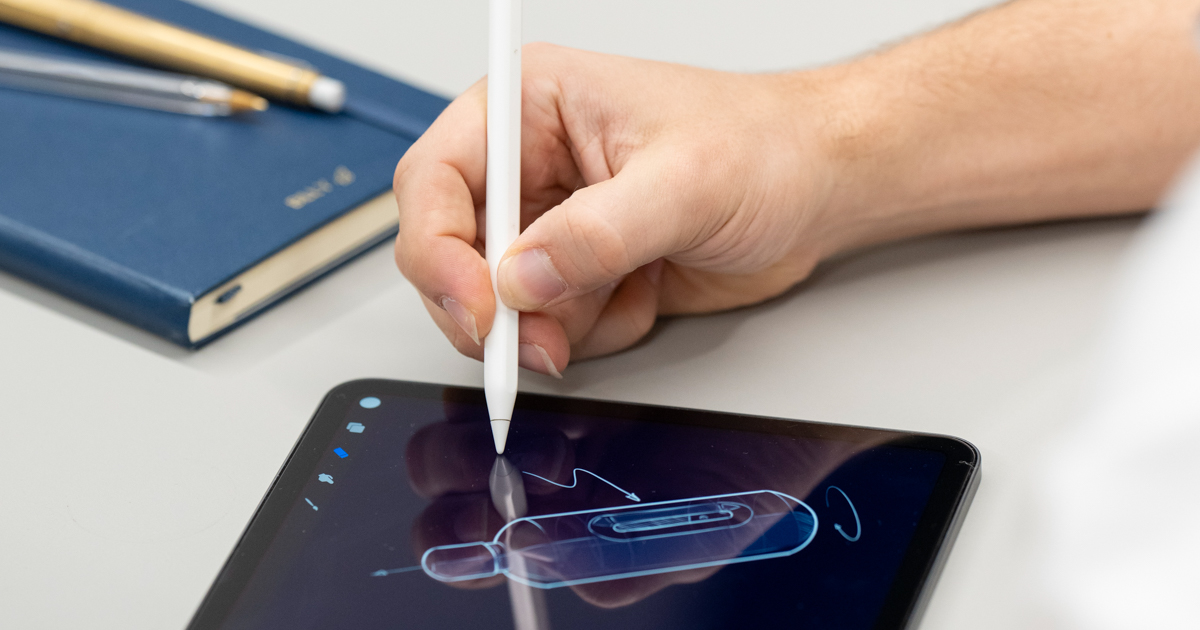
There is no requirement for the engineering to be complete. Early industrial design might involve little more than rough component layouts, sketches, ergonomic studies and simple physical models.
These relatively modest activities can have a considerable influence on the direction of development, helping establish the requirements that subsequent engineering decisions need to satisfy.
By developing industrial design and engineering in parallel, we can make more informed decisions throughout the process, reduce the need to revisit established work and arrive at a more coherent, considered physical product.