When people think about a prototype, they often picture something close to the finished product: the design has been developed, a physical version gets made, it goes into users’ hands, and then it moves towards production.
In practice, prototyping is a core part of physical product development, helping teams test assumptions, answer design questions and reduce uncertainty before committing to a finished solution.
At Studio Matter, we use prototypes throughout the design process to answer specific questions in the physical world. That might mean testing a mechanism, evaluating a sensor arrangement, understanding the size and weight of a wearable, or exploring how somebody responds to an interaction.
Each prototype gives us information that helps us make the next design decision with greater confidence, often long before the finished product begins to take shape.
Identifying what a prototype needs to test
At the beginning of a product development programme, some parts of the proposition will be well understood and others less certain.
Our approach is to identify the key unknowns early and work out which of them need to be explored through physical testing.
What would materially affect the direction of the design if the answer turned out differently from expected? And what is the simplest prototype we can build to find out?
By approaching development this way, prototyping becomes an ongoing part of the design process, helping inform decisions as the product evolves.
Each prototype should do one thing well.
Particularly in the earlier stages of development, we rarely expect one prototype to answer every question.
If we need to understand a mechanism, we might build a rough technical prototype purely to test that mechanism. If we need to evaluate the ergonomics of a wearable, we might create several non-functional models with different sizes, weights or material properties.
Each prototype only needs to be representative enough in the area being tested.
This matters because the more variables you introduce, the harder the result becomes to interpret.
If a prototype has the wrong weight, exposed wires, oversized electronics and an experimental interaction all at once, what exactly is a user responding to when they say they do not like it?
By isolating the characteristics we're evaluating, we can gather more focused feedback and draw clearer conclusions.
Separating form from function
This becomes particularly important when testing products with users.
There is a natural temptation to make one prototype that both demonstrates the technology and represents what the finished industrial design might look and feel like.
In practice, those objectives can work against each other.
Prototype electronics may be larger than production components. Batteries may be oversized. Wires may need to remain accessible. Sensors may be mounted differently. If all of this is packaged into something intended to represent the final product, users can end up responding to the compromises of the prototype rather than the proposition itself.
Telling somebody to “imagine this without the wires” or “imagine this being much smaller” only gets you so far. People naturally respond to the object they are actually holding or wearing.
We often address this by separating form and function into two distinct prototypes.
One communicates what the product should feel like. The other demonstrates what the product should do.
How we used this approach with Hope Tech
We used this strategy while developing Sixth Sense with Hope Tech, an accessibility wearable for visually impaired people.
When testing the proposition with users, we needed to understand both the physical experience of wearing the product and how its sensing and haptic feedback would work.
Trying to represent both in one development prototype would have compromised the test. A working prototype inevitably needed prototype electronics, sensors and wiring, which made it a poor representation of the form factor we envisaged for the end product.
We therefore developed two separate types of user prototype.
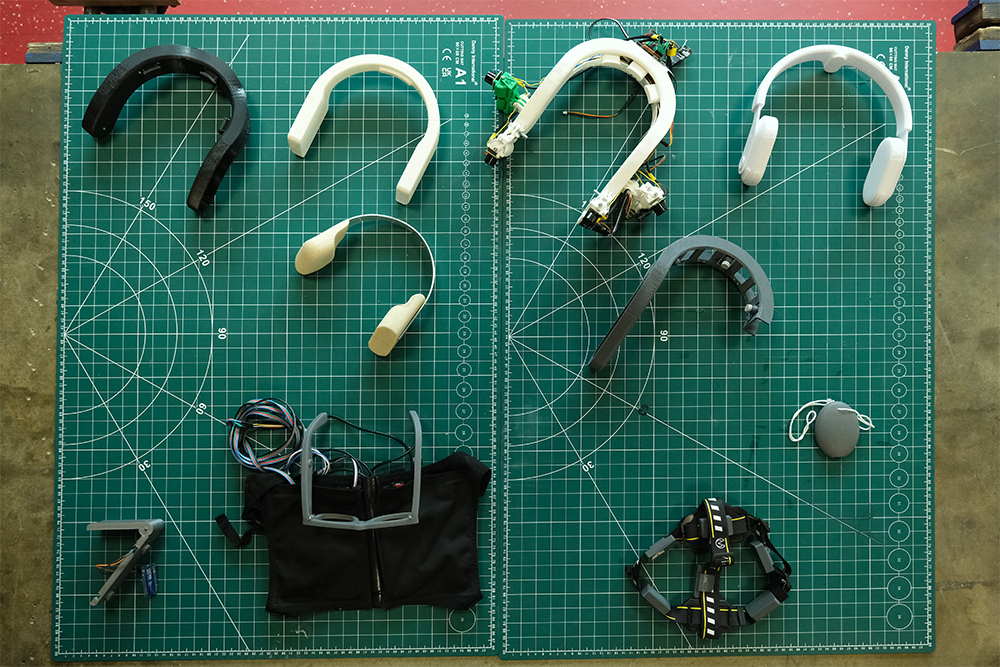
The first consisted of form prototypes representing the intended scale, weight and feel of the product, without any working electronics. These allowed users to evaluate the physical proposition without being distracted by development hardware.
Separately, we used working prototypes to demonstrate the sensing and haptic feedback. These could be larger and less refined, giving us the freedom to develop and test the functionality independently of the intended industrial design.
Users could experience both aspects of the proposition, with each prototype designed around the particular questions we wanted to explore.
Prototype to learn, not just to demonstrate
The value of a prototype lies in what we can learn from it, and how that information helps inform the next stage of development.
By identifying the questions we need to answer, isolating them where possible, and building only as much as is necessary to test them convincingly, we can make meaningful progress without committing prematurely to a particular design direction.
As development progresses, those separate strands gradually come together into increasingly integrated prototypes.
The level of fidelity should reflect what we're trying to understand at each stage. Sometimes a simple physical model or a crude test rig can provide everything we need to move forward.
Ultimately, prototyping helps us determine what a product should become, building confidence in the design through a series of informed decisions.
Developing a physical product?
We use prototyping throughout industrial design and product development to test key assumptions, answer design questions and build confidence before committing to manufacture.
Explore our prototyping and testing work, or talk to us about your project.